
Chalkboard Politics: Can Civil-Military Norms Survive a Polarized America?
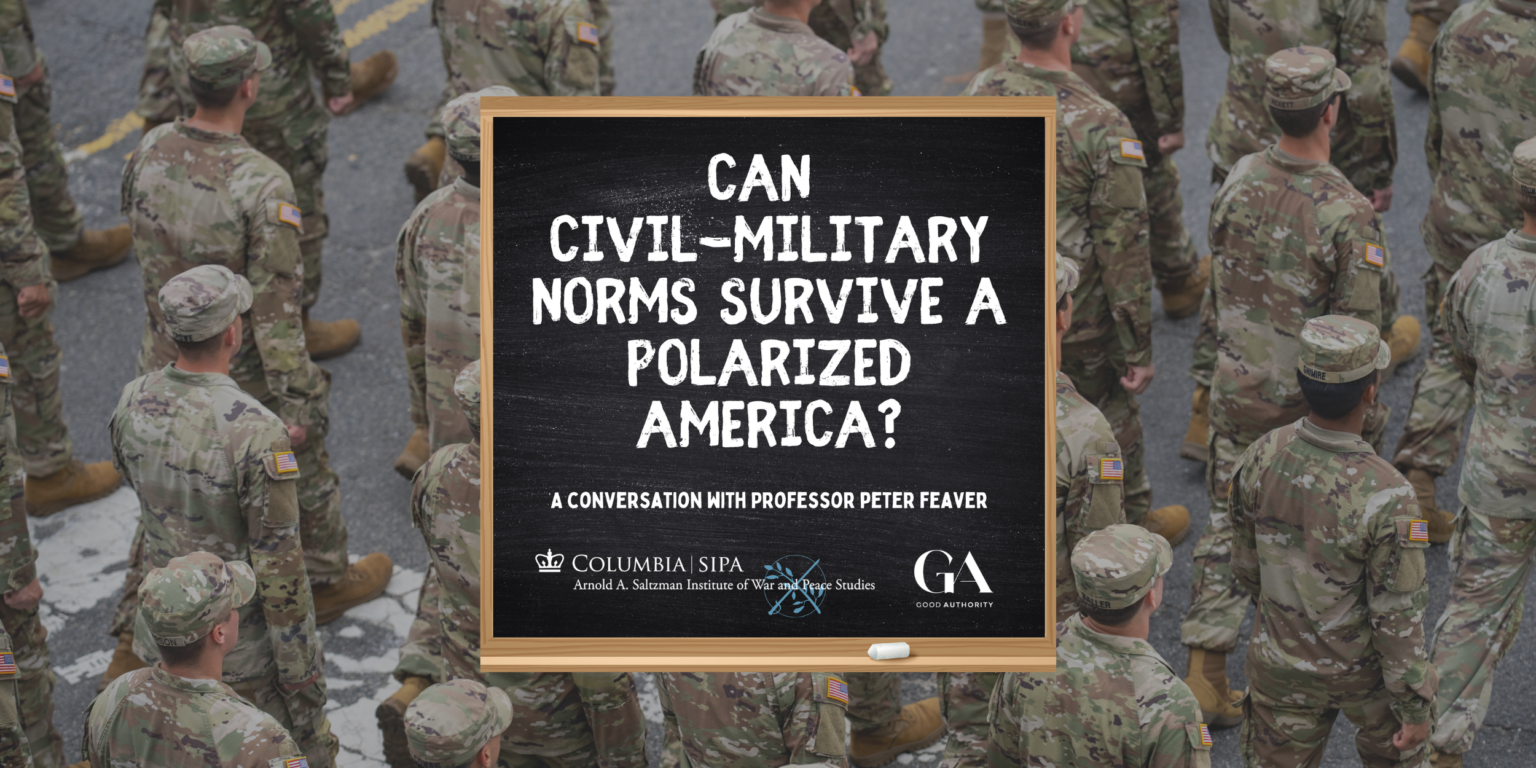
It’s been a rocky year for civil-military relations in the United States. Lethal boat strikes against alleged drug traffickers in the Caribbean and Eastern Pacific prompted questions about the legality of the U.S. military campaign. Several members of Congress who had served in military or national security roles then made a video imploring troops not to follow illegal orders.
In response, Defense Secretary Pete Hegseth censured Sen. Mark Kelly (D-Ariz.) for participating in the video. The Department of Justice investigated and unsuccessfully sought to prosecute Kelly and others involved in the video, including Sen. Elissa Slotkin (D-Mich.).
There have been other significant controversies. The Trump administration has also fired several high-ranking and well-regarded military officers, many of whom were from underrepresented groups, without explanation.
On top of all this, the U.S. war with Iran has put civilian decision-making about what it asks the world’s most powerful military to do under intense scrutiny. And Congress has complained – but given Republican control and, more importantly, its own recent history, done little else – about the Trump administration’s failure to seek authorization for the Iran war.
Where does this leave civil-military relations in the U.S.?
In this episode of Chalkboard Politics, the team explores the growing pressures facing civil-military relations in the United States during a period of stark polarization, institutional distrust, and heightened debate over executive power. Our guest is Peter Feaver, professor of political science and public policy at Duke University and one of the leading scholars of civil-military relations, civilian control, and national security decision-making. Drawing on both academic research and government experience, Feaver discusses the norms, institutions, and constitutional tensions that shape the American civil-military system.
Professor Feaver examines how the American constitutional system intentionally creates tension between civilian leaders and military institutions through checks and balances, making systems of trust, restraint, and professionalism central to democratic governance. The discussion then turns to the politicization of the military, including how partisan rhetoric, social media, and public polarization risk drawing military institutions into broader cultural and political conflict. Feaver also analyzes questions surrounding news leaks and resignations at the Pentagon, the legality of the Trump administration’s military decisions. He details the role of military officials in advising civilian leaders during crises, particularly in debates over Iran and the use of force.
The episode considers whether American democratic institutions can remain resilient under mounting political strain – or whether the erosion of longstanding civil-military norms will destabilize the constitutional balance between civilian authority, military professionalism, and democratic accountability.
You can listen to the episode here, or wherever you get your podcasts. All the Chalkboard Politics episodes can be found here.
Zara Williamson is a senior at Columbia College and the lead producer for the Chalkboard Politics podcast.
Elizabeth N. Saunders is professor of political science at Columbia University, and the author of “The Insiders’ Game: How Elites Make War and Peace” (Princeton University Press, 2024).
Stay up to date on all things politics and political science. Bookmark our landing page and sign up for Good Authority’s weekly newsletter by entering your email address in the box below.
Chalkboard Politics is a student-produced and student-hosted podcast that aims to connect concepts that students encounter in the classroom with real-world political events and to show how these concepts, which can sometimes feel abstract or inaccessible, help us make sense of the world. Building on the Saltzman Student Scholars program at the Saltzman Institute, the podcast reflects a broader vision: one in which students are not just consumers of knowledge, but active producers, working alongside faculty to bridge the gap between academic frameworks and real-world questions of war, peace, and international politics.
For each episode, our student-producers choose the topic, the guests, and the questions with the support of Saltzman Institute Director Elizabeth Saunders. The podcast will feature curated conversations with Institute faculty and invited guests (from Columbia and beyond) across topics of interest to the Saltzman community. It will also seek to make connections across expertise and subjects that are not often in conversation. Topics will be guided by student-submitted questions, recorded live or pre-produced with broader community input.
Chalkboard Politics is produced by the Arnold A. Saltzman Institute of War and Peace Studies at Columbia University, in partnership with Good Authority. It is made possible with the support of Columbia’s Department of Political Science and the School of International and Public Affairs.
Contact the Chalkboard Politics Team: If you have any comments or questions about Chalkboard Politics, or ideas for future segments, please email us at chalkboardpolitics@columbia.edu.